
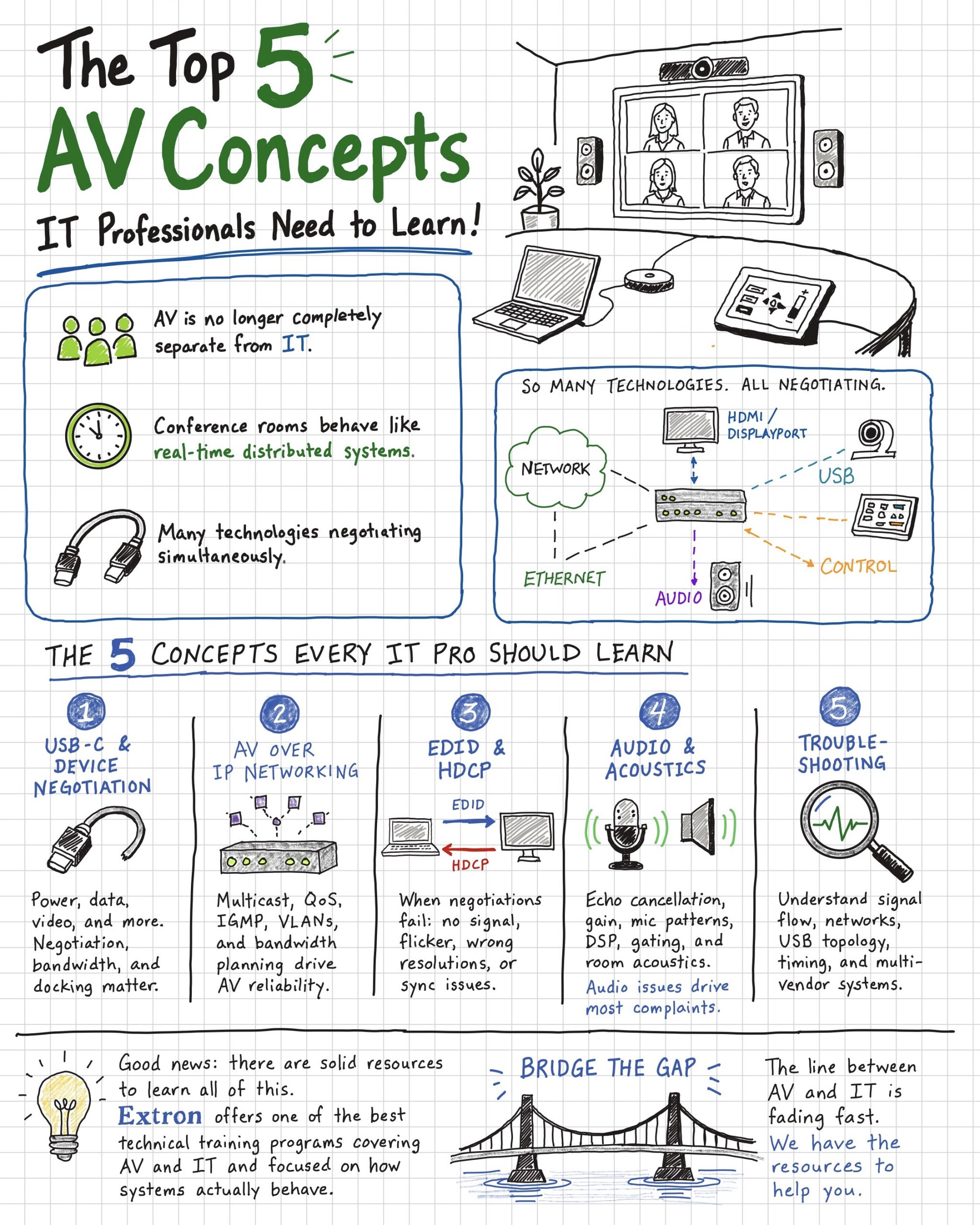
The IT professionals who understand these concepts are becoming incredibly valuable right now because AV is no longer separate from IT.
Conference rooms now behave more like real-time distributed systems than traditional AV setups, with dependencies on latency, synchronization, and device negotiation.
That “simple” room with a display, camera, mic, USB-C cable, speakers, and a touch panel involves many technologies negotiating simultaneously across USB, Ethernet, HDMI, control, audio, and video. More and more, it’s the IT teams supporting these rooms.
If I had to pick the 5 things every IT person should learn to make their job easier, it would be these:
#1 USB-C and Device Negotiation
USB-C is not just a connector. It can carry power, USB data, DisplayPort, and Thunderbolt/USB4 tunneling for additional protocols like Ethernet.
Understanding device negotiation, bandwidth allocation, power contracts, and docking behavior matters a lot in conference rooms. A lot of room failures start here.
#2 AV over IP Networking
AV is now data. That means multicast traffic, QoS, IGMP snooping, VLAN segmentation, and latency/bandwidth planning all directly affect AV reliability. If you want to work with AV at scale, this knowledge isn’t optional.
#3 EDID and HDCP
One of the biggest hidden layers IT folks don’t expect. Devices constantly exchange capability data (EDID) and content protection states (HDCP), and when those negotiations fail, you get no signal, flickering, wrong resolutions, or intermittent sync issues. Once you understand this layer, troubleshooting changes completely.
#4 Audio and Acoustics
A room can have perfect video and still feel broken if the audio is bad. Echo cancellation, gain structure, mic pickup patterns, DSP routing, gating, and basic room acoustics are all foundational. In collaboration spaces, audio issues are the most common complaint.
#5 Troubleshooting
The best AV engineers are really systems troubleshooters. You need to understand signal flow, network behavior, USB topology, timing dependencies, and multi-vendor interoperability. Engineers who can isolate the root cause fast are hard to find.
The good news: there are solid resources to learn all of this. Extron offers one of the best technical training programs in the industry, covering both AV and IT, and focuses on how systems actually behave, not just product operation. If you’re just getting started, Extron AV Principles courses are a great entry point. All you need is an Extron Insider account to request enrollment.
The line between AV and IT is fading fast, and we have the resources to help you bridge the gap.