
I get why people think small UC conference rooms are simple…until they have to support them at scale.
From the outside, it looks easy. A display, a camera, a mic, some speakers, and a USB-C cable.
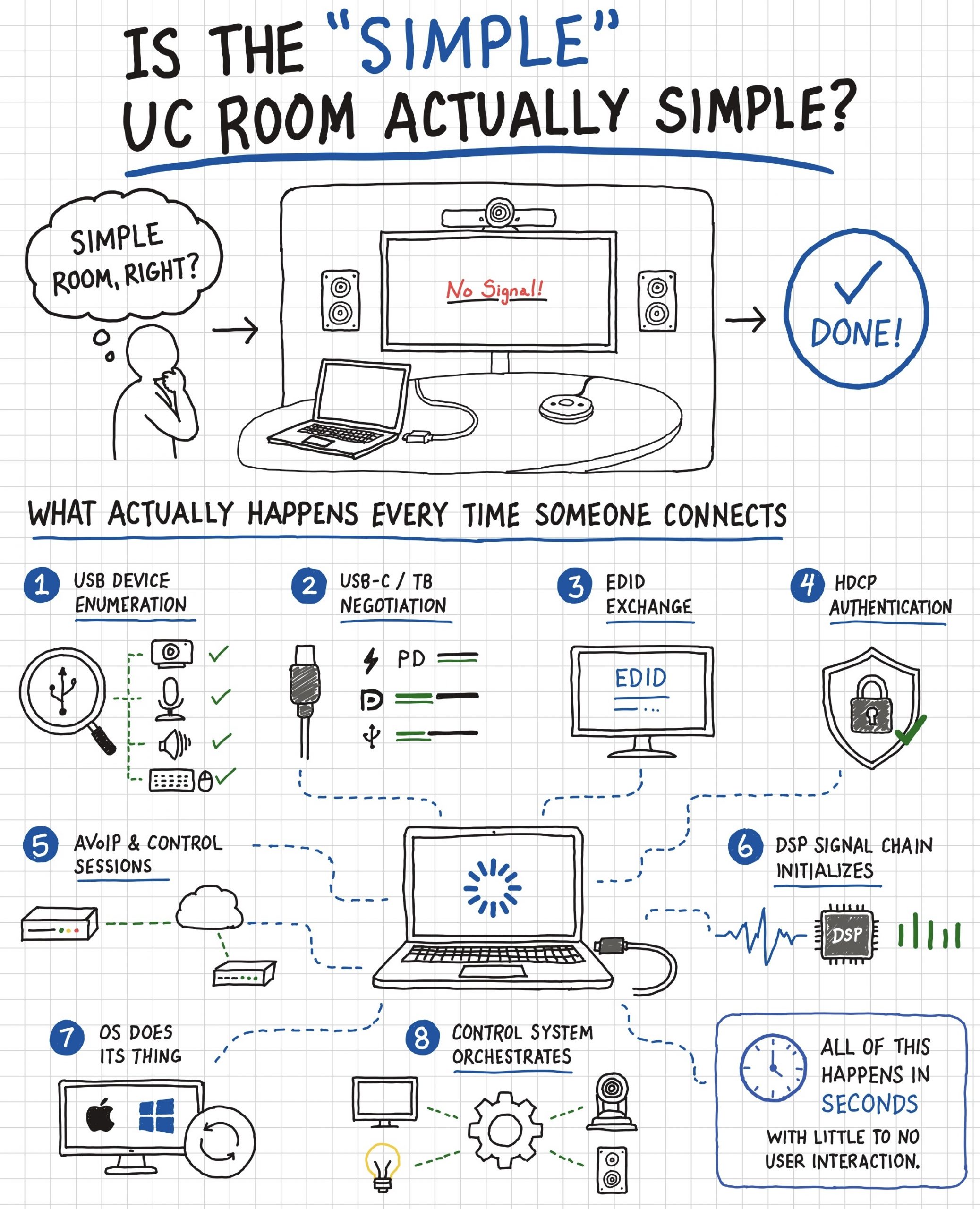
But that “simple room” is a real-time distributed system with dozens of independent technologies negotiating simultaneously. It’s less like plugging into a monitor and more like joining a live system that has to converge instantly. When one piece fails, users say: “The room doesn’t work.”
Here’s what actually happens every time someone connects:
USB device enumeration kicks off. The host discovers cameras, mics, speakers, and HID devices. Descriptors are exchanged, drivers are loaded, and bandwidth is negotiated across the entire USB topology, including hubs and extenders.
USB-C or Thunderbolt negotiation runs in parallel. Power Delivery roles are established, DisplayPort Alt Mode may activate, and bandwidth gets split dynamically between video, data, and peripherals.
EDID exchange happens. Displays advertise supported resolutions, refresh rates, HDR, DSC, and audio capabilities. Bad EDID handling can force incorrect display modes or break compatibility entirely.
If HDCP is required, authentication runs across the full signal chain. A single failure gives you a black screen or no audio. If the room uses AVoIP, devices start multicasting and API-based control sessions open, adding timing dependencies on top of everything else.
The DSP signal chain initializes. AEC reference paths are established. Automixing, gating, noise reduction, and routing all spin up immediately. A 50 ms mismatch in an AEC reference path can severely degrade echo cancellation.
Meanwhile, the OS is doing its own thing: suspending USB devices, reassigning default audio and video endpoints, renegotiating display modes, or applying driver updates mid-session. The control system is orchestrating everything else: displays power on, inputs switch, cameras recall presets, occupancy triggers automation.
All of this is expected to happen in seconds with little to no user interaction.
These “simple” rooms are hard. Not because AV or IT is complicated in isolation. It’s because modern UC spaces are where real-time media, USB, operating systems, network protocols, security constraints, and unpredictable humans all collide.
And these issues don’t show up in one room. They show up in 50, 100, 500 rooms. A bad EDID strategy, unstable USB topology, or inconsistent network behavior doesn’t fail once. It fails everywhere.
The best rooms aren’t built from individual products. They’re engineered as systems, where USB topologies are controlled, video paths are deterministic, audio is properly tuned, and network behavior is designed rather than assumed. That system-level thinking is what separates reliable rooms from ones that generate tickets, and it’s why at Extron we put so much effort into developing systems rather than a collection of components.